
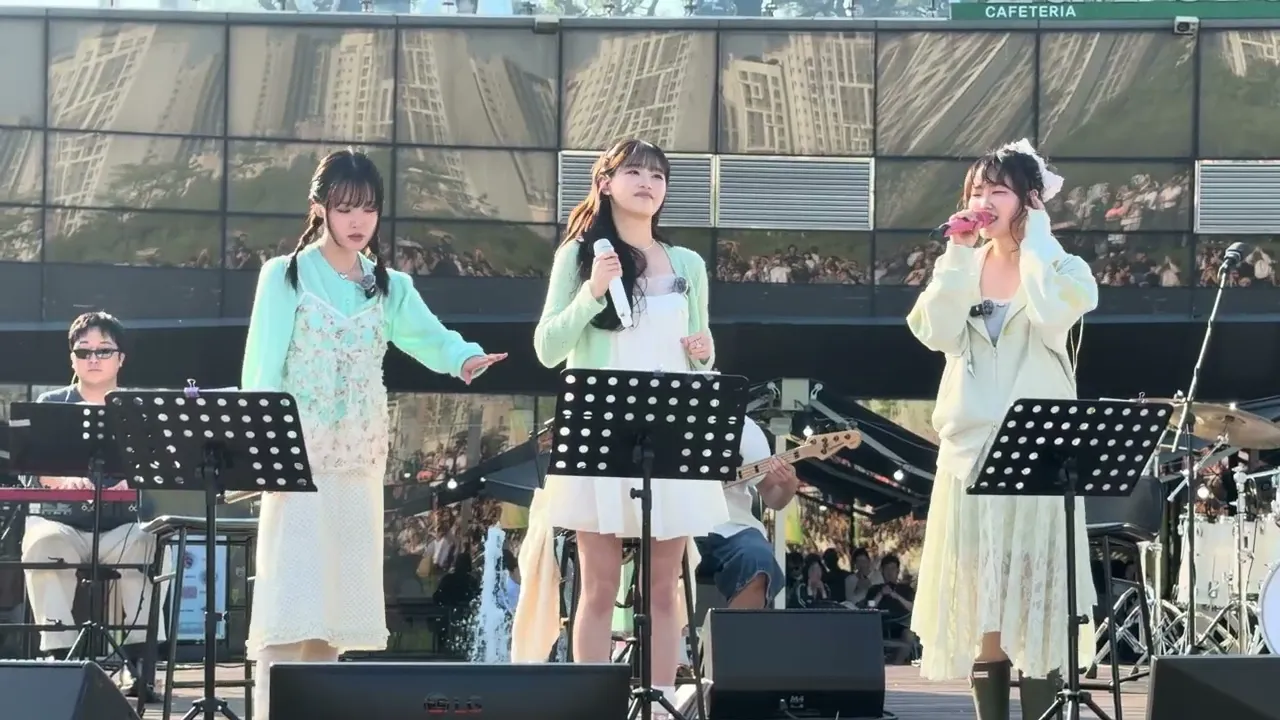
Chuu has performed a busking session for her “Chuu can do it” channel. Although we still have to wait for the episode to be released, we’ve already got some Shorts from her, Hanroro and AKMU’s Lee Su-hyun. Thanks to xxoczukxx on YouTube, we also have a video of these three performing Seo Young-eun’s 2003 song “I’m Not Alone” (혼자가 아닌 나). I’m taking this as this Sunday’s K-pop throwback.
Seo Young-eun’s “I’m Not Alone” is a song that offers comfort and quiet strength. It speaks to people who have been hurt, felt lonely, or struggled to keep going, but it doesn’t dwell on sadness. Instead, it gently reminds you that hard times pass, sunlight returns, and even when life feels heavy, you are not truly alone. This line encapsulates that message most effectively.
힘이 들 땐 하늘을 봐 / 나는 항상 혼자가 아니야
“When things are hard, look at the sky / I am never truly alone.”
Vocabulary & grammar breakdown
힘이 들다
- means “to have a hard time,” “to struggle,” or “to be difficult”
- literally, it is related to 힘 meaning “strength” or “energy”
- when Korean says 힘이 들다, it often means life feels emotionally or physically hard
-ㄹ 땐 → 들 땐
- -ㄹ 때 means “when…”
- 땐 is a shortened form of 때는
- so 힘이 들 땐 means “when things are hard”
- this contraction is very common in lyrics and everyday speech, and it sounds softer and more natural
하늘을 봐
- 하늘 means “sky”
- 보다 means “to see” or “to look at”
- 봐 is the casual form of 보다
- so 하늘을 봐 means “look at the sky”
- in Korean songs, the sky often symbolizes comfort, openness, hope, or something bigger than your pain
혼자가 아니야
- 혼자 means “alone”
- 혼자가 아니다 means “to not be alone”
- 아니야 is the casual form of 아니다
- with 항상, meaning “always,” the line becomes “I am always not alone”, or more naturally, “I am never truly alone”
Language & emotion tip
What makes this line so comforting is its simplicity. There are no intricate metaphors; instead, it presents two gentle ideas: when life becomes difficult, look up; and when you do, remember that you are not alone. The phrase “하늘을봐” (looking at the sky) feels particularly powerful because it suggests lifting your gaze away from your pain for a brief moment. This makes the lyric feel warm, calming, and quietly reassuring, rather than dramatic.