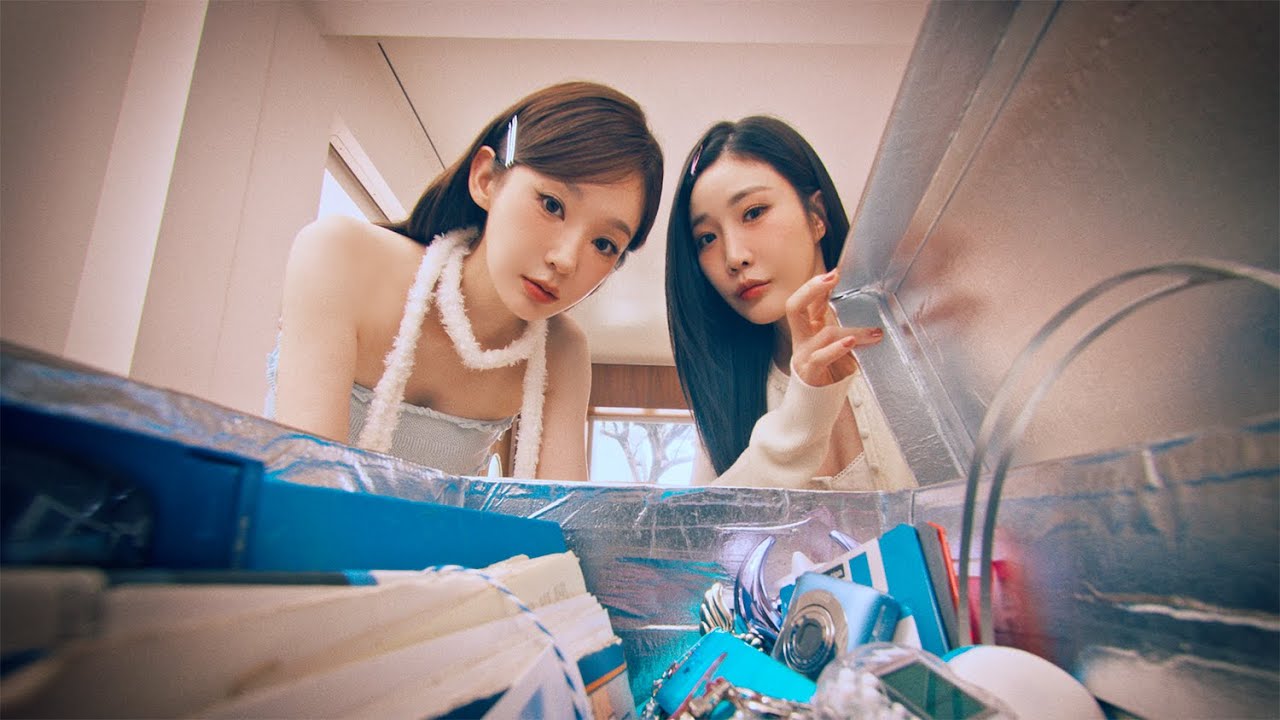
After joining a new label, Davichi return with “Time Capsule”, and once again they prove that nobody does emotional storytelling quite like them.
The song captures the bittersweet feeling of opening a time capsule — reading the dreams of your younger self, realizing how much has changed, and smiling through the ache of nostalgia.
Let’s take a closer look at this line from the lyrics:
“방긋하고 웃어버리며
이 타임캡슐 어릴 적
내가 쓴, 내게 쓴 말 한가득”
“Smiling softly,
this time capsule holds
a heap of words I once wrote to myself as a child.”
—
💫1️⃣ 방긋하고 웃어버리며 – “Smiling softly”
• 방긋하다 → to smile brightly / sweetly
• 웃어버리다 → to end up smiling (emphasizing completion or inevitability)
• -며 → “while / as” (connecting two actions)
💡 Grammar note:
The verb -어/아 버리다 expresses doing something completely — sometimes unintentionally or with a sigh of acceptance.
So 웃어버리며 feels like “I can’t help but smile.”
Combined with 방긋하고, it paints a picture of warmth and resignation — a gentle, nostalgic smile.
—
🕰️2️⃣ 이 타임캡슐 – “This time capsule”
• 이 → this
• 타임캡슐 → time capsule (loanword from English)
💡 Cultural note:
Time capsules (타임캡슐) are a common metaphor in Korean ballads for preserving childhood dreams or past feelings — a way of confronting who you once were versus who you’ve become.
—
🧒3️⃣ 어릴 적 – “When I was young”
• 어리다 → to be young
• -ㄹ 적 → “when / at the time (of doing something)”
→ 어릴 적 = “in my childhood / when I was little”
💡 Grammar tip:
The structure V/A-(으)ㄹ 적 is a poetic or literary form often used in reflective writing. It adds a nostalgic tone — perfectly fitting for a song about memories.
—
✍️4️⃣ 내가 쓴, 내게 쓴 말 한가득 – “A heap of words I wrote to myself”
• 내가 쓴 → that I wrote (from 쓰다, “to write”)
• 내게 쓴 → written to me (-에게 marks the recipient)
• 말 한가득 → “a heap / full of words” (한가득 = full, packed with)
💡 Grammar note:
The repetition 내가 쓴, 내게 쓴 highlights both roles — the writer and the reader — showing how time splits the self in two: the past and the present.
—
💌 Why It Matters
Davichi’s “Time Capsule” is a gentle reminder that growing up doesn’t mean letting go — it means learning to smile at what once was.
The structure of this lyric mirrors that duality: a soft -며 connection between now and then, a “capsule” bridging the two versions of the self.
It’s both linguistically beautiful and emotionally grounded — a perfect example of how Korean grammar carries feeling.
💭 If you could open a time capsule from your childhood, what do you think your younger self would have written to you? Drop a ⏳ if this song stirred a memory.